Full-scale data hall environment
one hall, not a corridorModules combine into a single, spacious data hall that is easy to service — not a corridor of containers.
 DataCore™
A factory-built platform on the patented CrossRow architecture: four models from 60 kW to 2.4 MW per module, delivered as a single wide-aisle data hall rather than a row of containers.
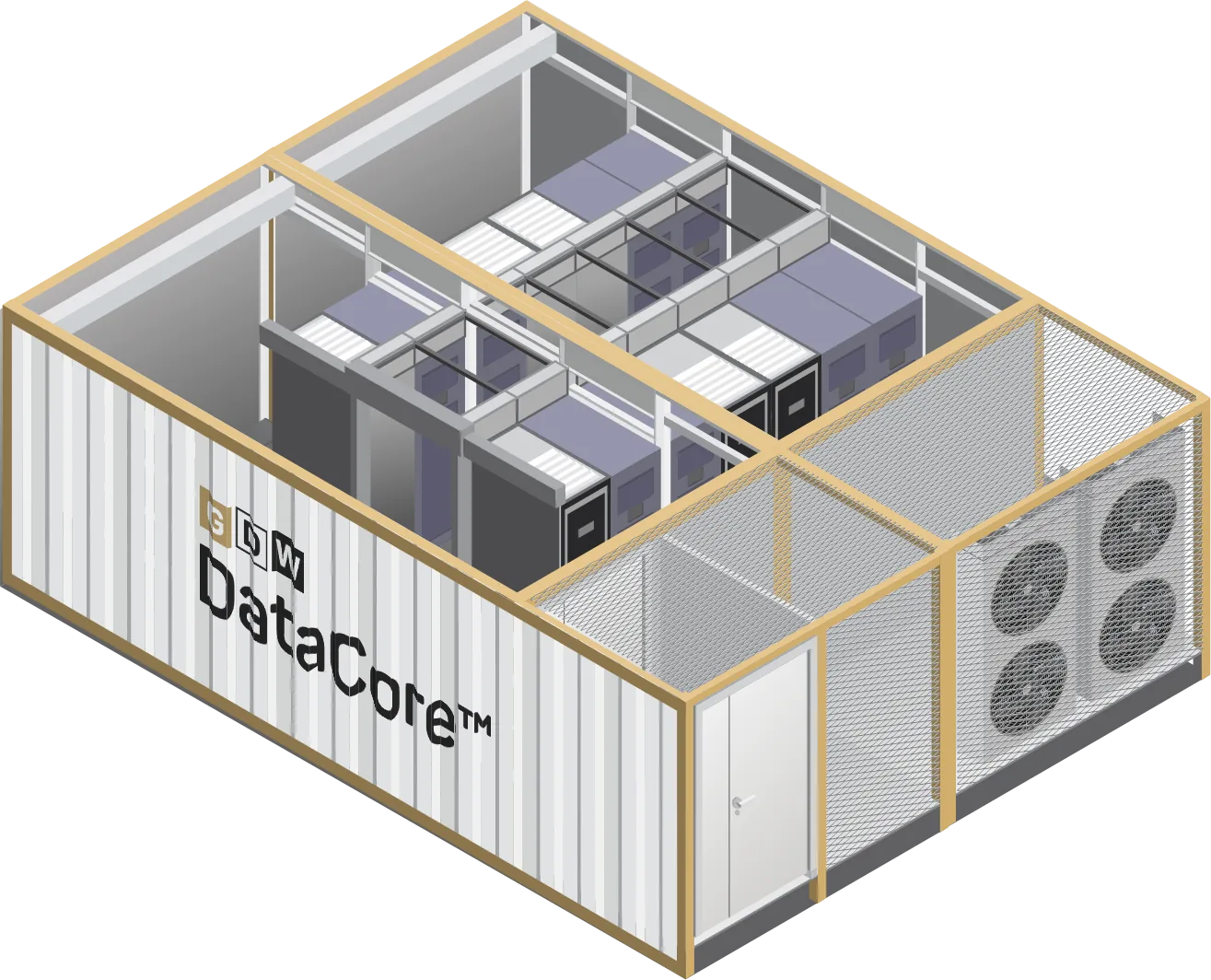
DataCore is a modular platform for building turnkey data-center infrastructure. CrossRow is the architecture underneath it — a patented way of joining modules so that the result reads as one data hall rather than a row of containers.
The platform includes a block-modular structure, server and communication racks, uninterruptible power supply and power distribution, a precision cooling system, monitoring of the engineering systems, and integrated physical and fire safety.
Protected by patent of the Republic of Kazakhstan № 10959, "Modular data processing center and method of its construction", granted 01.08.2025.
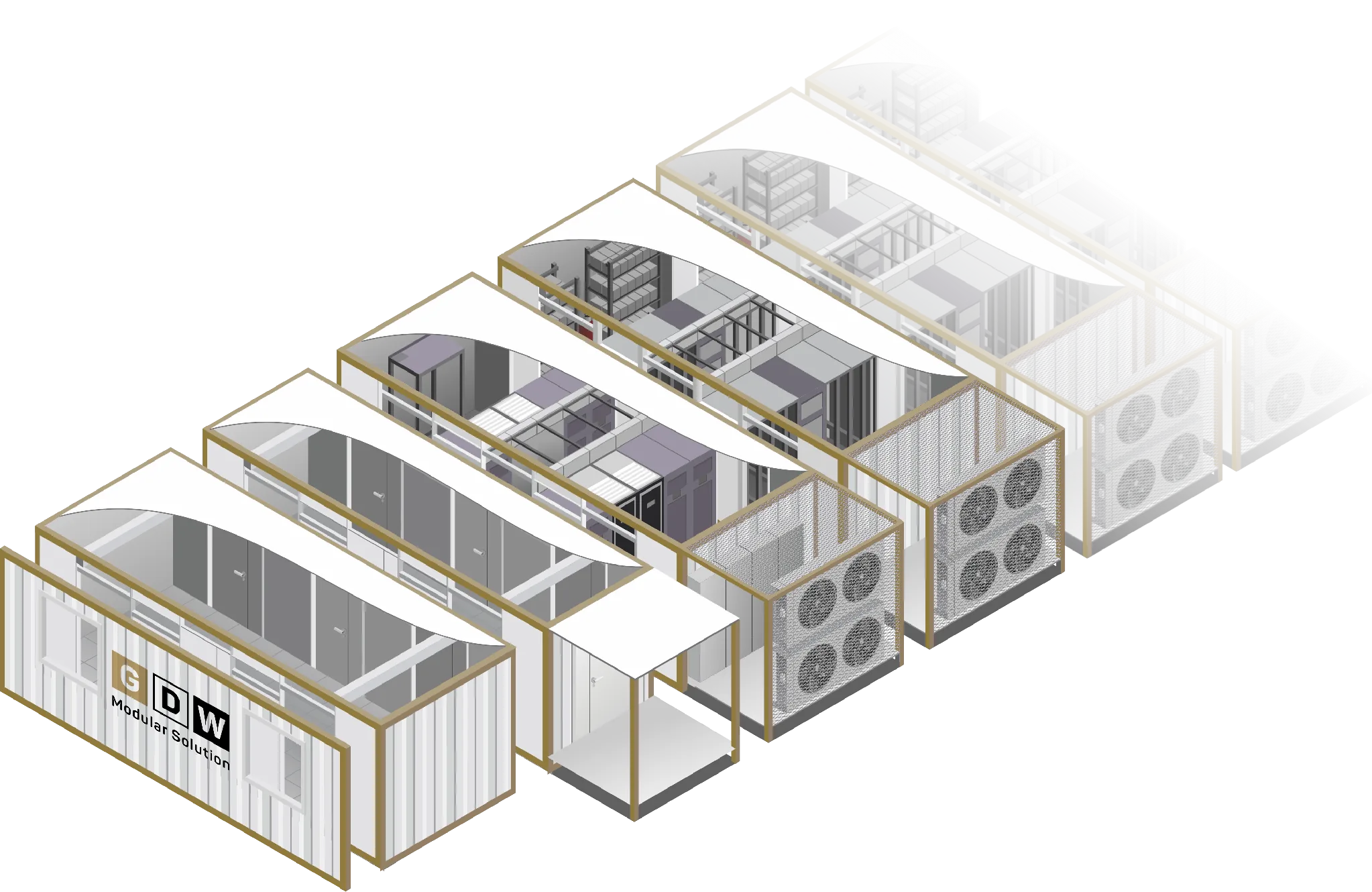
Built on the patented CrossRow technology. Five properties separate the platform from container-based modular products.
Modules combine into a single, spacious data hall that is easy to service — not a corridor of containers.
Flexible adaptation to different power, layout and client requirements off one platform.
Capacity is added as demand grows, a module at a time, without stopping the halls already running.
The platform is designed as a digital twin worked out to every node: BIM on Autodesk (Revit, Infraworks), thermal and CFD modelling on Cadence.
An integrated solution from one manufacturer — compatible systems and a single line of technical support.
The wide-aisle hall, the flexible configuration and the unlimited scaling are properties of the CrossRow architecture itself — protected by patent of the Republic of Kazakhstan № 10959.
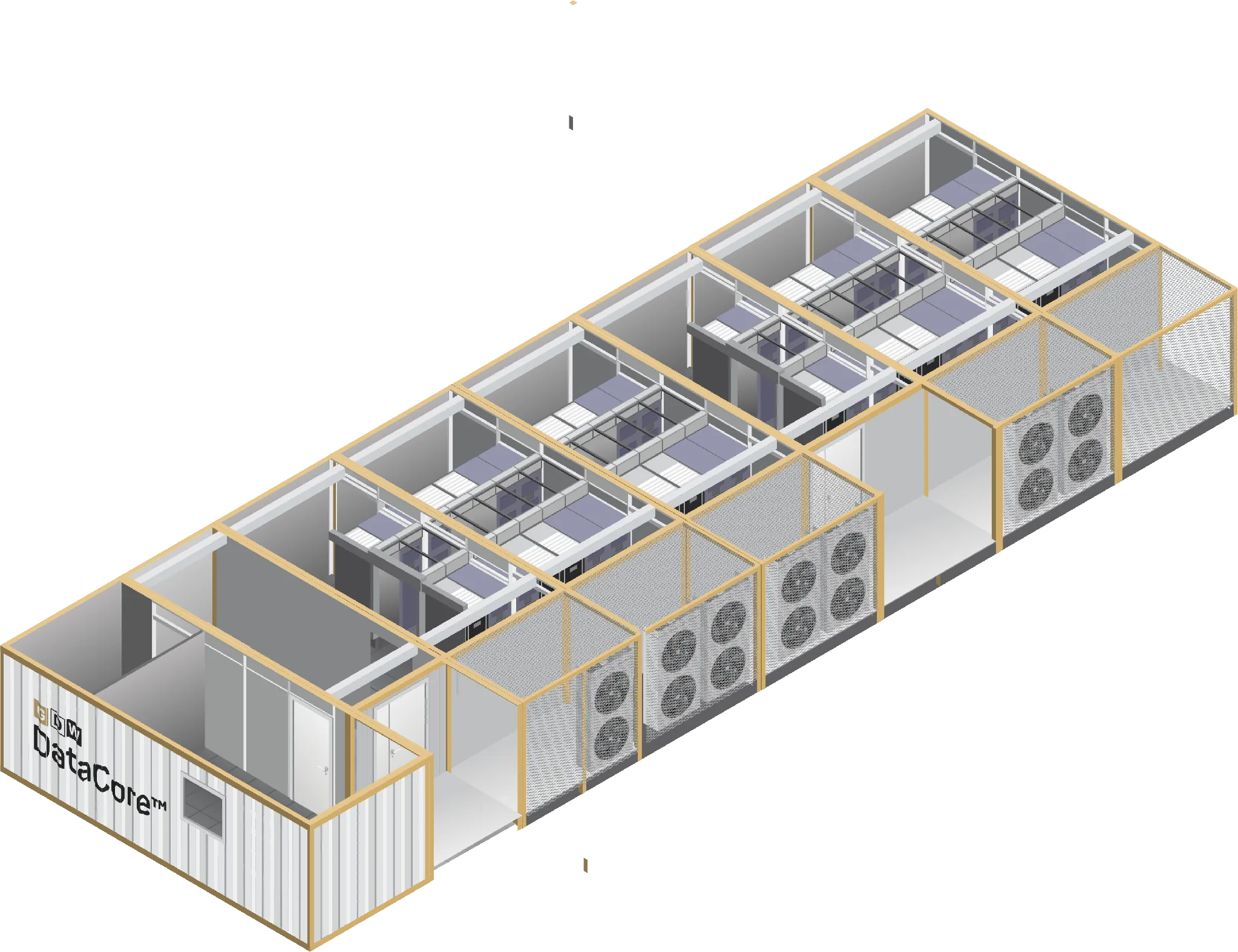
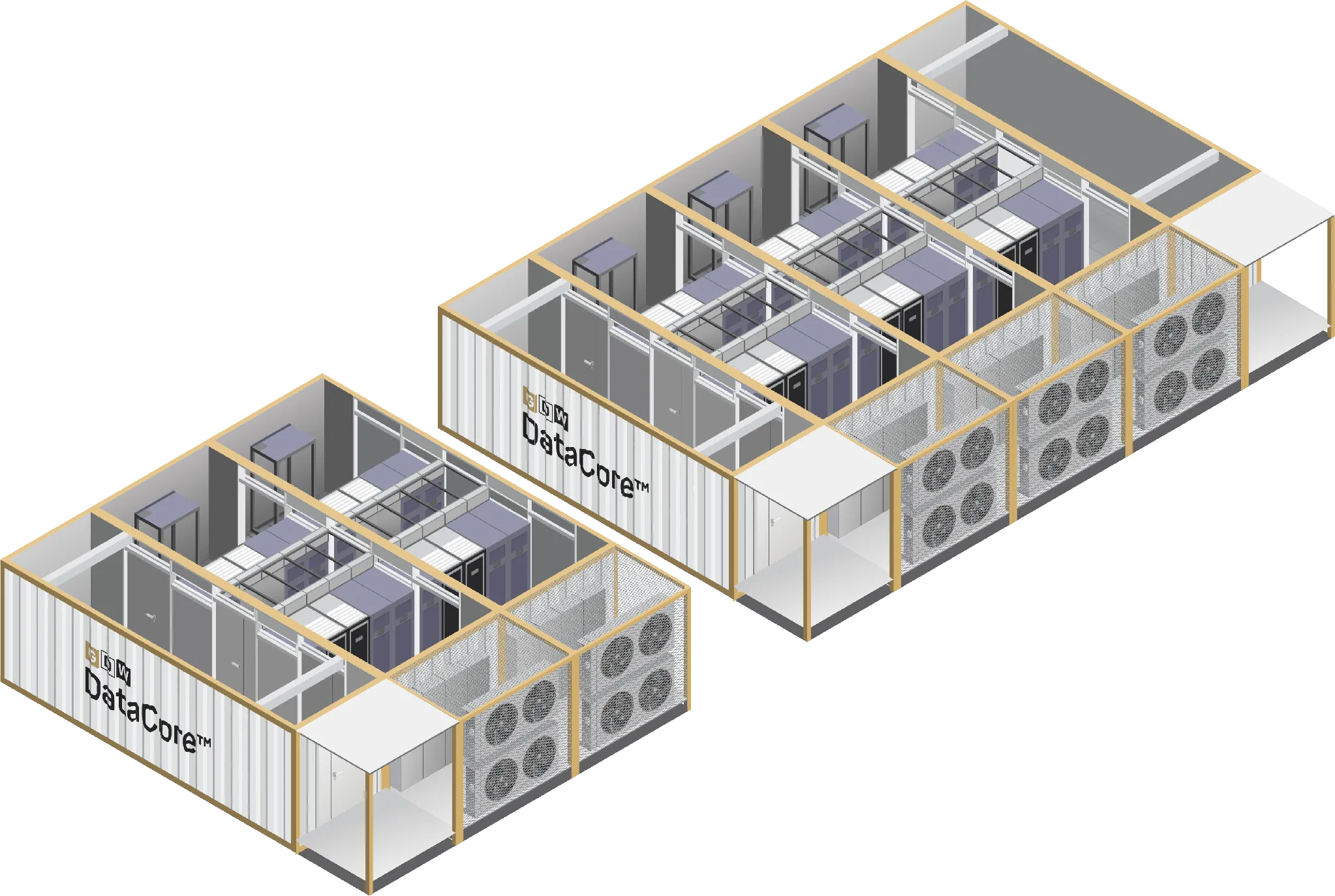
Four configurations off one platform, all on the patented CrossRow architecture: wide-aisle data halls, 150+ configurations, phased scalability, and a single engineering ecosystem from one manufacturer. Every unit ships integrated — cooling, distribution, UPS, substation, DGS, gaseous suppression, ACS and CCTV, racks, SCS and monitoring.
Integrated platform · single hall
A monoblock solution with a single data hall. It retains the key qualities of a full data center — ease of operation, reliability, manageability and fault tolerance — at minimum dimensions.
S140-16-21S200-20-21C1
Multi-hall modular data center
A monoblock solution with a dedicated data hall and a dedicated energy block. The separation gives safe operation, serviceable engineering systems, split zones of responsibility and the reliability of a full-size data center.
M400-20-21FC1
Scalable multi-block platform
The data hall and the energy block sit in separate buildings, and the site grows on a cluster principle. A full alternative to a traditional large data center: compute and engineering capacity are added in phases, without stopping the systems already running.
X1200-96-22FC1
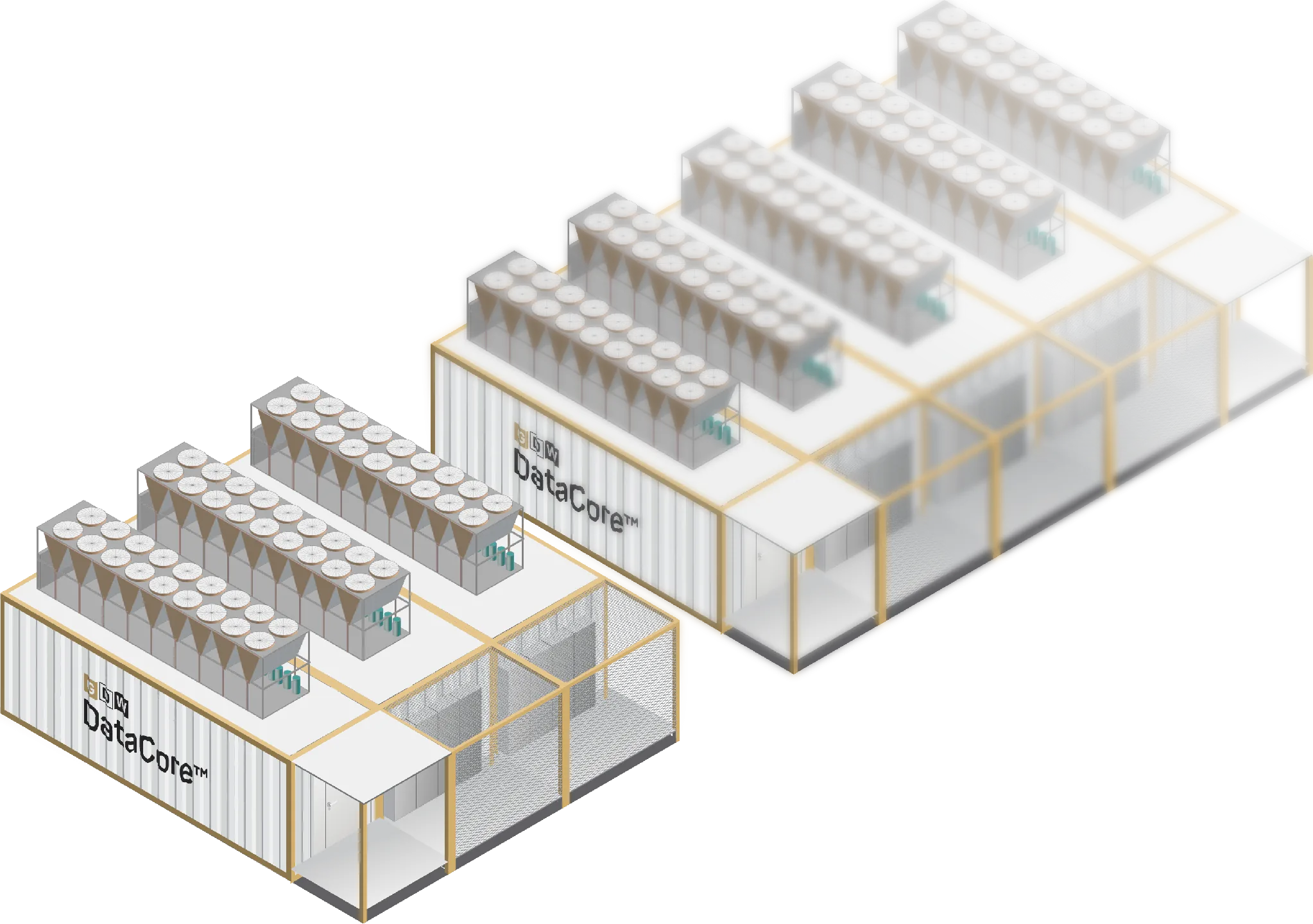
AI infrastructure platform · Q4 2026
A multi-block solution developed specifically for high-density AI compute and liquid-cooled infrastructure. The cluster architecture grows compute capacity in stages, forming scalable AI clusters with no limit on size or power.
Liquid-cooling units carried on the module roof; blocks join into an AI cluster.
Q4 2026liquid cooling
Nine standard IT ratings from 60 to 1 200 kW. Rack count depends on the density the client designs to; redundancy, temperature envelope and Tier level are the same across the range.
| IT POWER, kW | 60 | 100 | 150 | 200 | 300 | 400 | 600 | 800 | 1200 |
|---|---|---|---|---|---|---|---|---|---|
| Max racks at 7 kW | 8 | 14 | 22 | 28 | 42 | 58 | 86 | 114 | 172 |
| Max racks at 15 kW | — | 6 | 8 | 12 | 20 | 26 | 40 | 54 | 80 |
| Max racks at 30 kW | — | — | — | 6 | 10 | 14 | 20 | 26 | 40 |
Modules are built on a rigid steel frame with the envelope, floor and rack fit-out engineered as one product, so what arrives on site is a building, not a kit.
The power chain is redundant end to end, and the module connects to the site through external interfaces — no cables are pulled inside during installation.
The cooling system is rated for outdoor temperatures from −40 °C to +45 °C, and it stays on the uninterruptible supply — the basis of the continuous-cooling design HITEC Power Protection publishes as its client case.
Every module ships with monitoring, fire protection and physical security fitted, and passes two rounds of testing — at the factory and on site.

| Field | Value |
|---|---|
| Utility model | № 10959 — "Modular data processing center and method of its construction" |
| Technology | CrossRow — the architecture behind the DataCore platform |
| Application | № 2025/0780.2, filed 26.05.2025 |
| Granted | 01.08.2025 |
| Holder | LLP "GENESIS Engineering Project Management Corporation", Kazakhstan |
| Authors | Ruslan Pushilin · Alexandr Tuleushev · Denis Malykhin |
GDW was founded in 2022 as the next step for the group's engineering expertise — from delivering complex engineering projects to developing its own products and finished solutions. In 2023 the company completed its first full product, the GDX-1500 data center. In 2025 it created the DataCore platform: a modular solution on the patented CrossRow architecture, built for efficiency, fault tolerance and flexible scaling.
Product and R&D arm of RP Partners Group, carrying the engineering expertise the group had accumulated since 2002 into its own products.
First complete product — a 1.5 MW standalone data center with an administrative block, developed for PIT "Alatau" and later published by HITEC Power Protection as a reference case.
Modular range on the patented CrossRow architecture: 150+ configurations from 60 kW to 2.4 MW per module, with an AI configuration following in Q4 2026.
The functional structure is built around the DataCore product and covers four directions. Each one owns a stage of the product's life, and together they close the loop from the first calculation to service on a running site.
Platform design and the digital twin.
Deliverable: shop drawings, BIM model, CFD report.
Calculations, BIM, CFD, configuration selection.
Fabrication and assembly of modules.
Deliverable: a module fitted out and FAT-passed.
Shop drawings, steel, systems fitted at the plant.
Commissioning and handover on site.
Deliverable: a hall running under load, handed over.
FAT, start-up, 24/7 stability testing.
Warranty and service through the lifecycle.
Deliverable: uptime maintained on a live site.
Maintenance, incident response, regional integrators.
Engineering capacity behind the four departments, per the 2026 update: 6 lead engineers (2 with attestation), 4 architects and a structural steel engineer, 8 design engineers, 6 project managers, and 35 installation and commissioning engineers.
Fabrication sits with partner plants rather than in-house: CBC Group in Kazakhstan and Automatikos Sistemos in Lithuania, with Imstalcon Group and EPC Group for steel and general construction.
Design of the DataCore platform: engineering calculations, BIM modelling on Autodesk (Revit, Infraworks), thermal and CFD modelling on Cadence, and the digital twin — the platform is worked out to every node and every bolt. The department shapes the S / M / X / AI configurations against the requirements of a specific client.
Every module exists first as a coordinated model: cold-aisle containment over the rack rows, overhead cable routing, switchgear and support rooms in the head section, condensers in the fenced service bay.
Autodesk Revit and Infraworks for the building and the site; Cadence for thermal and CFD analysis of the hall. Both product designs — GDX-1500 and the DataCore module — were developed this way.
150+ configurations across four models. The department fixes rating, redundancy, cooling scheme and rack count per brief, then issues the shop drawings the factory builds from.
Authors of the CrossRow patent sit in this department — Ruslan Pushilin, Alexandr Tuleushev and Denis Malykhin. Six lead engineers and eight design engineers carry the work.
Fabrication and assembly of DataCore modules at the plants of the group and its partners — CBC Group and Automatikos Sistemos in Lithuania. Quality control against detailed shop drawings; power, cooling and security systems are fitted into the module at the factory stage.
Steel fabricator for GDW modules in Kazakhstan. Imstalcon Group and EPC Group cover steel fabrication and general construction on site.
Panevėžys, Lithuania. Founded 2000, 246 staff, specialised in electrical distribution and control equipment. Holds a dual role: distribution, and the module assembly site in the EU.
Rigid steel frame, cladding not less than 2 mm, mineral-wool sandwich panels to EI 60, waterproof joints. Racks, distribution, UPS, in-row cooling and security are installed and wired before shipment.
Assembly follows the shop drawings issued by R&D, with control at each stage — the same documentation the digital twin is built from.
Commissioning and handover on the client's site. All equipment passes factory acceptance testing before it ships; final start-up of the engineering systems and their stability testing in 24/7 mode is carried out by the manufacturer's own specialists.
Every module is powered, run and witnessed at the plant. What arrives on site has already been proven as an assembly, not as a set of parts.
Final start-up of power, cooling, monitoring and safety systems, performed by the manufacturer rather than a local subcontractor.
Systems are held under load and tested for stability in continuous operation before the hall is handed over.
35 installation and commissioning engineers across the group, with attestation for construction and installation work in high-seismic zones of Kazakhstan.
Warranty and service support across the whole product lifecycle: maintenance of the engineering systems, rapid incident response, and support through the network of integrator partners in the regions served.
Scheduled maintenance of power, cooling, monitoring and safety systems for as long as the module is in operation.
Rapid response on the engineering systems, with monitoring data from every UPS, cooling unit and distribution board feeding the response.
Warranty support runs from handover and covers the engineering systems as an assembly, since the module was tested as one at the factory and again on site.
One manufacturer across the systems means one spares list and one support line; the as-built BIM model and the module's documentation stay with the site for its life.
The DataCore ecosystem defines four levels of participation. Distribution runs through five markets; service in each region sits with a local integrator; the key partners are profiled on the following slides.
Manufacturers whose solutions are integrated into the platform — OEM partner status.
Sells the equipment, and arranges investment and financing around it.
Service and warranty support in a region, with no tie to its own sales.
Fabrication and assembly of the modules.









These are the independent OEM vendors behind the module bill of materials — the companies the word "partner" properly applies to.
Professional distributor of equipment and materials for IT infrastructure, on the market since 2004. The portfolio covers power supply, cooling (HVAC), structured cabling and server-infrastructure solutions.
| Field | Value |
|---|---|
| Location | Kazakhstan / Central Asia |
| On the market | Since 2004 |
| Portfolio | Power, HVAC, IT & DC infrastructure |
| Brands | Rittal, Schneider Electric, Kehua Tech, DKC, Huawei and others |
A manufacturing company founded in 2000, specialised in electrical distribution and control equipment, with a staff of 246. In the DataCore ecosystem it holds a dual role: distribution, and the production site for module assembly in the EU.
| Field | Value |
|---|---|
| Location | Lithuania / East Europe |
| On the market | Since 2000 |
| Portfolio | Power Shelter, UPS, Automation |
| Brands | Rittal, Schneider Electric, ABB, Siemens and others |
One of the largest suppliers on the Belarusian market of equipment for data centers, structured cabling, LANs, cooling systems and telecom infrastructure. On the market for more than 20 years, representing 11 global brands.
| Field | Value |
|---|---|
| Location | Belarus |
| On the market | Since 2000 |
| Portfolio | Power, IT & DC infrastructure |
| Brands | Lapp, Rittal, Phoenix Contact, CommScope, Fluke and others |
Company of RP Partners Group and holder of the patent for the DataCore / CrossRow technology. In the ecosystem it acts as the integrator: service and warranty support in the region.
| Field | Value |
|---|---|
| Role | Integrator — service and warranty support |
| Group | RP Partners Group |
| IP | Holder of patent KZ № 10959 |
| Region | Kazakhstan |
A full-cycle contractor for the design and construction of data-center infrastructure, adapting projects to the local regulatory and technical base. Works directly with global equipment manufacturers; warranty on delivered projects — up to 3 years.
| Field | Value |
|---|---|
| Competencies | Modular data centers, site security systems, Tier I–IV certification |
| Warranty | Up to 3 years on delivered projects |
| Model | Works directly with global manufacturers |
| Market | Uzbekistan |
| Web | datanet.uz |
Design, fabrication and support of data centres are carried out in an in-house engineering environment. The same environment is available to the client as a product: calculations and diagrams, product structures, the engineering archive, the common data environment of the project and operations are linked together and run on one set of data.
Each module handles its own part of the work and exchanges data with the rest.
Engineering calculations and diagrams: short-circuit currents, selectivity, heat dissipation, structured cabling.
Products and configurations: structure, execution variants, selection rules.
Engineering archive: versions, revisions, product structure, CAD files.
Common data environment of the project: statuses, transmittals, documentation packages.
Document control: registration, routes, execution tracking.
Development management: requirements, changes, stages and gates.
Delivery projects: schedules, resources, budgets, milestones.
Processes and approvals: configurable routes without programming.
Clients and counterparties: a single base, relations, interaction history.
Sales: deals, commercial proposals, multi-party supply.
Finance: invoices, payments, plan against actual by project.
Operations: assets, maintenance, regulations, service requests.